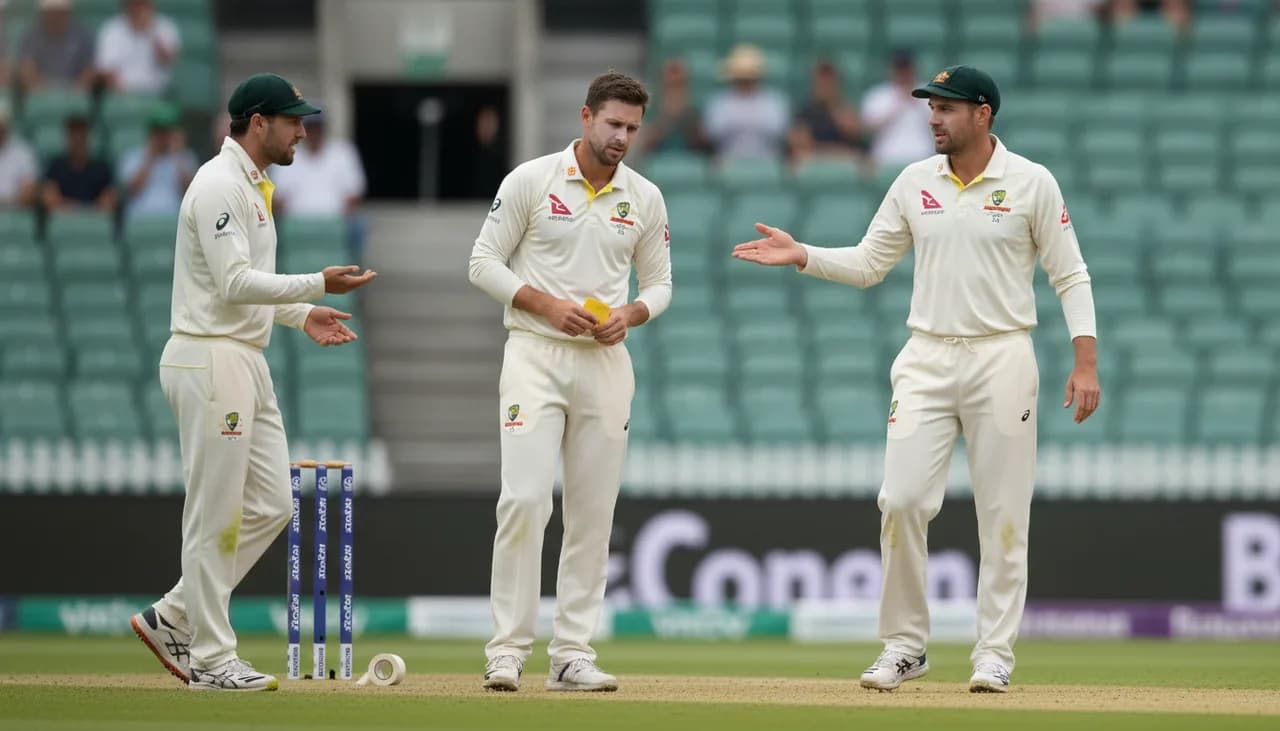

COLOMBO — The echoes were painfully familiar. As Afghanistan’s Gulbadin Naib sealed a dramatic eight-run victory over Australia, securing his team’s first-ever semi-final berth and eliminating the former champions, a damning verdict from a former great cut through the noise. “It smacks of England,” said Ricky Ponting on commentary.
The reference was to England’s disastrous 50-over World Cup defence in 2023, a campaign defined by muddled thinking, stubborn selection, and a failure to adapt. In the space of a week in Sri Lanka, Australia’s T20 World Cup campaign suffered an identical, spectacular collapse, derailed by a lack of clarity and a glaring absence of a Plan B.
A Campaign Built on Shifting Sands
Australia arrived in the Caribbean and USA as one of the favourites, boasting a squad brimming with world-class talent and recent success, including a commanding 4-1 series win over the West Indies in February. Yet, from the outset, their strategy seemed conflicted. The selection of Cameron Green as a spare top-order batter, despite his proven prowess in the middle order, and the inclusion of only three specialist spinners for conditions demanding slow-bowling mastery, hinted at a confused identity. Were they a power-hitting juggernaut or a tactically adaptable unit? The answer, it turned out, was neither when the pressure mounted.
The warning signs flashed brightly in the group stage loss to India. Chasing a modest 206, Australia’s batting order, rigid in its structure, failed to build a single meaningful partnership. The reliance on individual brilliance over collective strategy was exposed. As former Australian captain Aaron Finch noted, “The batting has been a real concern. There’s been no fluency, no partnerships of substance when it’s mattered.”
The Sri Lankan Stumble: A Failure to Adapt
It was in Sri Lanka, however, that the campaign fully unravelled. Facing a must-win scenario against Afghanistan on a slow, turning Pallekele pitch, Australia’s muddled selection reached its peak. They dropped their leading wicket-taker of the tournament, leg-spinner Adam Zampa, citing a minor illness. His replacement, Ashton Agar, was thrust into a high-stakes game with minimal recent bowling. The decision backfired spectacularly. More critically, the batting approach on a deteriorating surface was bafflingly one-dimensional.
Afghanistan’s spinners, led by the brilliant Rashid Khan, strangled the Australian innings. Instead of recalibrating, promoting a hitter like Tim David, or using the depth of the crease, the top order fell in a heap attempting aggressive shots against the spin. The lack of a contingency plan was stark. “They looked like they had one way to play, and when that was blocked, they had no answer,” observed commentator and former player Isa Guha.
Key Factors in the Collapse
The defeat was a culmination of several critical failures:
- Top-Order Fragility: David Warner’s inconsistent form and Mitch Marsh’s struggle to anchor the innings left the middle order perpetually under pressure.
- Spin-Struggle Syndrome: A historical weakness against quality spin bowling resurfaced at the worst possible time.
- Tactical Inflexibility: The refusal to adapt batting orders or bowling plans to specific match-ups and conditions.
- Over-reliance on Individuals: Waiting for a Glenn Maxwell miracle, rather than building a structured chase.
Leadership and Planning Under the Microscope
Captain Mitch Marsh and coach Andrew McDonald now face intense scrutiny. The decision-making in Sri Lanka, particularly around Zampa’s omission and the batting order’s rigidity, will be heavily debated. The campaign raised fundamental questions about Australia’s T20 philosophy. In an era where teams like India and England boast immense squad depth and tactical flexibility, Australia’s approach appeared dated and stubborn.
The contrast with Afghanistan was telling. They played to their precise strengths, maximising their world-class spin attack and batting with clear, situational awareness. Australia, for all their firepower, looked like a team unsure of its best XI or its method. As journalist Geoff Lemon wrote in The Guardian, “Australia’s World Cup ended not with a bang but a whimper, a confused muddle of poor shots and poorer planning.”
A Painful Echo and a Necessary Reckoning
Ponting’s “England” comparison will sting, but it is apt. Both were reigning white-ball champions who arrived at a World Cup with a seemingly strong squad, only to be undone by a failure to evolve and adapt. For Australia, a team that prides itself on ruthless efficiency in ICC events, this early exit represents a significant failure.
The inquest will be thorough. It must address not just selection for this tournament, but the broader pipeline and strategy for T20 cricket. With the next T20 World Cup just two years away, Australia has little time to waste. The lesson from Sri Lanka is clear: in modern T20 cricket, power alone is not enough. Without clarity of thought, tactical nuance, and the courage to adapt, even the most talented squads will be left behind, their campaigns ending not with glory, but with the familiar smack of a opportunity wasted.