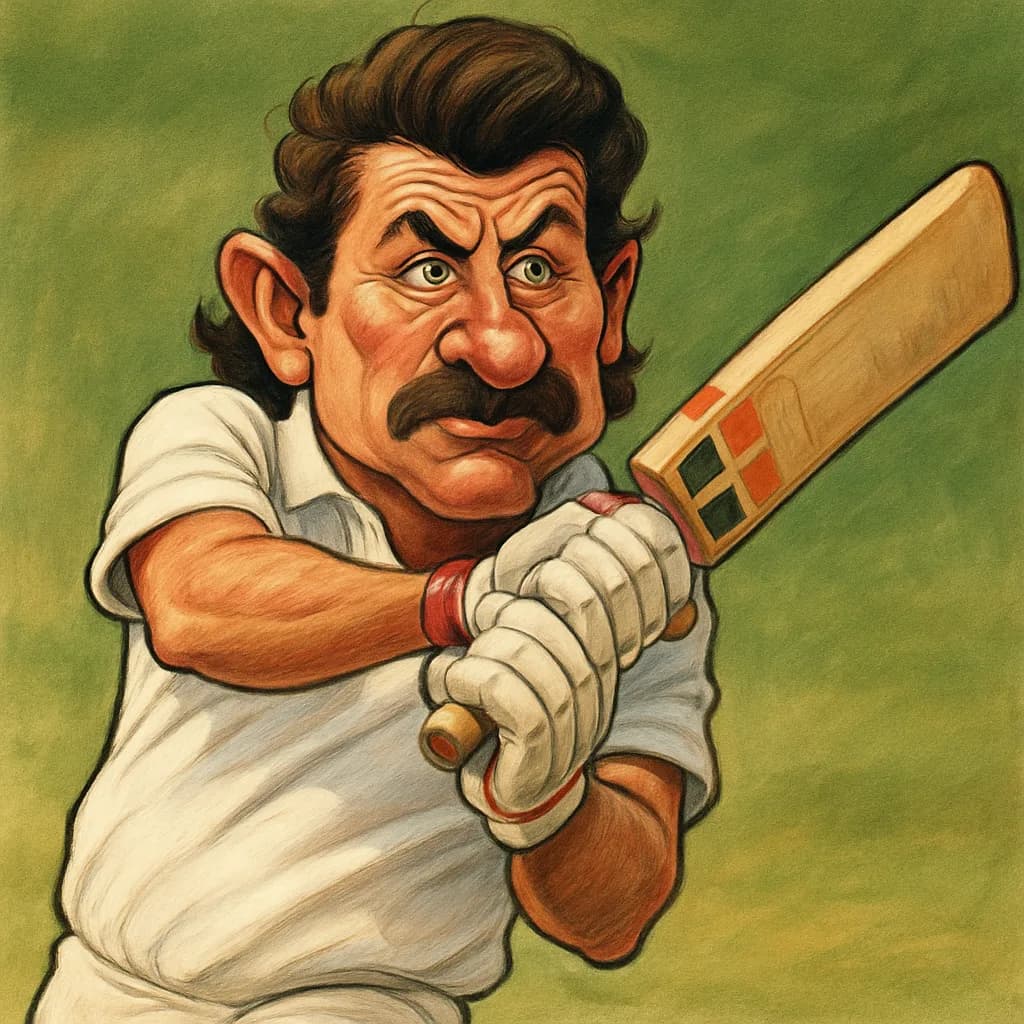
LONDON — Robin Arnold Smith, the South African-born batsman whose ferocious square-cutting and fearless hooking made him a cult hero for England during the bleak years of the late 1980s and early 1990s, has died at the age of 62. His death, after suffering a stroke, was announced by his family, who described him as "one of life's great adventurers."
Smith, known universally as "The Judge" for his stern, bespectacled countenance at the crease, was a beacon of pugnacity in an England side often found wanting against the rampant West Indian pace attacks of the era. His career, spanning 62 Tests and 71 One-Day Internationals between 1988 and 1996, was defined by courage against the short ball and a rare ability to stand tall when others faltered. Yet, his story is one of triumph on the field followed by a profound and public struggle off it, a battle with his own demons that lasted long after he retired his England cap.
The Making of a "Judge"
Born in Durban, South Africa, on September 13, 1963, Robin Smith learned his cricket on hard, bouncy pitches, an upbringing that would later define his technique. He and his elder brother, Chris, moved to England to pursue county cricket, qualifying through their English mother. Robin joined Hampshire in 1982, where his aggressive style quickly marked him as special. His Test debut came against the West Indies at Headingley in 1988—a baptism of fire facing the likes of Malcolm Marshall, Curtly Ambrose, and Courtney Walsh. He top-scored in both innings, announcing himself with a defiant 64 in the second, and instantly earning the respect of the cricketing world.
Smith’s technique was unorthodox but brutally effective. He favoured the back foot, possessing a repertoire of savage cuts and pulls that could demoralise any bowling attack. He was, as former England captain Michael Atherton once wrote, "the best player of fast bowling I played with." This was never more evident than during his epic, match-saving 148 at Edgbaston in 1993 against a West Indian attack still featuring Ambrose and Walsh, an innings widely regarded as one of the greatest displays of courage and skill by an English batsman in the modern era.
Peak and the Inevitable Decline
At his peak, Smith was a cornerstone of the England middle order. His career highlights are a testament to his ability against the very best:
- A magnificent 167 not out against Australia at Edgbaston in 1989.
- A crucial 128 in the 1992 World Cup final against Pakistan.
- Averaging over 100 in the victorious 1992-93 Test series in India.
- Reaching a career-high Test ranking of number two in the world in 1991.
However, the advent of a new generation of English batsmen and, more critically, a subtle change in the laws regarding leg-side fielding, began to expose a perceived weakness against high-quality spin. His form dipped, and after being dropped following the 1995-96 tour of South Africa, he never played for England again. He retired from first-class cricket in 2003, leaving a record of 14,419 runs at an average of 41.84, with 42 centuries.
The Battle After the Battle
Retirement proved to be the beginning of Smith's greatest challenge. The structured life of professional cricket gave way to a void he struggled to fill. In candid interviews later in life, he spoke openly about his descent into depression, alcohol abuse, and financial ruin. The fearless hero who had stared down 90mph deliveries was brought low by internal struggles he could not name for many years. "I was in a very dark place," he later admitted. "I didn't know who I was anymore. Cricket had been my identity, and without it, I was lost."
His marriage broke down, his business ventures failed, and at one point he contemplated suicide. It was a desperate call to the Professional Cricketers’ Association that began his long road to recovery. With their support, he sought therapy, confronted his addiction, and began to rebuild his life. He found solace in coaching and mentoring young players, often speaking about the importance of mental health—a subject taboo during his playing days.
A Legacy of Courage, On and Off the Pitch
In his later years, Smith regained a sense of peace. He remarried, found happiness with his family, and was a warmly received presence at cricketing events, his famous grin once again evident. The cricket world remembered not just the batsman of old, but the man who had fought his second innings with the same grit he showed against Ambrose. Former teammate and friend, Angus Fraser, summed it up: "What people will remember is a fantastic, courageous cricketer. But they should also remember a bloke who was honest enough to talk about his problems and help others."
Final Wicket
Robin Smith’s legacy is dual-faceted. He is immortalised in highlight reels for his thunderous strokeplay, a symbol of resistance in an era of English fragility. Statistically, he finished with 4,236 Test runs at an average of 43.67, a record that speaks of consistent quality. But his enduring impact may well be his humanity—his public vulnerability and subsequent recovery, which helped to chip away at the stigma surrounding mental health in sport. He was, as his nickname suggested, a judge of the short ball, but in life, he became a testament to resilience. As tributes poured in from across the globe, the image was consistent: that of a fearless competitor, a beloved teammate, and ultimately, a survivor. The Judge’s final verdict was on life itself, and he faced it with the same unflinching courage he showed at the crease.