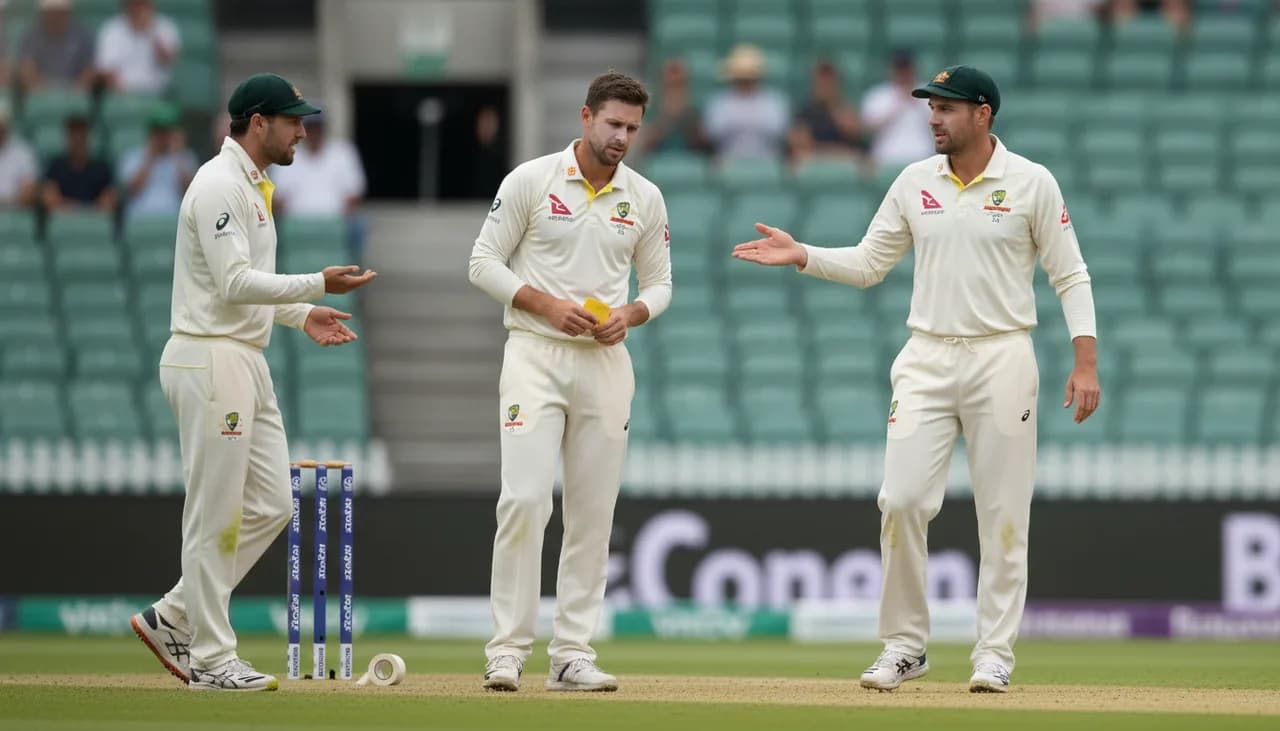
ADELAIDE — The Adelaide Oval, bathed in the soft glow of a pink twilight, is a stage built for batting grandeur. Yet, on the opening day of the third Ashes Test, Australia’s top order authored a script of self-inflicted ruin, a performance so littered with loose strokes that it could only be described as cavalier and casual.
After winning a crucial toss on a dry, true surface offering minimal early threat, the home side inexplicably gifted England a route back into the series, stumbling to a precarious 273 for 8 by stumps. This was not a day defined by unplayable deliveries or inspired English bowling; it was a day surrendered through a collective lapse in temperament, a series of soft dismissals that handed momentum to a visiting side desperate for a foothold.
A Foundation of Sand
The tone was set alarmingly early. David Warner, looking uncharacteristically fluent and having navigated the first hour, attempted an audacious reverse scoop off the bowling of Mark Wood. On 32, with the score a steady 61, he skewed the ball straight to Zak Crawley at slip. It was a shot of pure hubris, a dismissal that spoke of a mind already wandering from the discipline Test cricket demands. Former Australian captain Ricky Ponting, on commentary, could only lament, "That’s a gift. An absolute gift. There was no need for it whatsoever."
Marnus Labuschagne, the world’s number one batter, followed suit in a manner that has become worryingly familiar. After a scratchy start, he seemed to be finding his rhythm, moving to 21. Facing the part-time off-spin of Joe Root, he lunged at a wide, full delivery with hard hands, driving it directly to cover. It was a poor choice of shot to a ball that demanded respect, not aggression. The pattern of dismissals was becoming a theme:
- Warner: 32, reverse scoop to slip.
- Labuschagne: 21, loose drive to cover.
- Steven Smith: 22, flicked lazily to mid-wicket.
Smith’s wicket was perhaps the most damning. Having looked utterly serene, he faced the gentle medium pace of Chris Woakes. On a day where patience was the required currency, he attempted to whip a straight ball through mid-wicket, only to pick out the fielder placed precisely for that shot. It was, as described by England’s Stuart Broad, "a dismissal of comfort, not pressure."
England’s Relentless Discipline
To dismiss England’s role would be unfair. While the wickets were gifts, the wrapping paper was provided by relentless English discipline. After the early fireworks of Wood, captain Ben Stokes deployed his resources shrewdly. The veteran pairing of James Anderson and Stuart Broad, playing together for the first time in the series, bowled with impeccable control, building pressure that undoubtedly contributed to the Australian rashness.
Most notably, Chris Woakes, often underrated in Australian conditions, was exemplary. He consistently attacked the stumps and found just enough movement to trouble both edges. His reward was the key wickets of Smith and the dangerous Cameron Green, who edged behind attempting a forceful cut. Woakes’ figures of 3 for 48 from 18 overs were a testament to the value of persistent, accurate seam bowling.
England’s fielding, so ragged at times earlier in the series, was sharp and supportive. Every half-chance was clung onto, and the catching, particularly Crawley’s snaffle of Warner and Harry Brook’s low grab to remove Alex Carey, was clinical. They created a ring of pressure that Australia’s batters seemed desperate to break with force, rather than absorb and wear down.
The Counter-Punch and the Collapse
Amid the carnage, Usman Khawaja stood as a monument of common sense. Playing with the calmness that has defined his remarkable career resurgence, he anchored the innings with a patient 58. His partnerships, however, were constantly undermined. Travis Head threatened briefly with a characteristic flurry, but fell for 28, caught behind chasing a wide one from Woakes. Mitchell Marsh, the hero of the previous Test, blasted a quickfire 27 before holing out to deep square leg.
The lower order offered scant resistance. Alex Carey’s disappointing series continued as he nicked off for 15, and Pat Cummins was bowled by a superb Anderson delivery that did justice to the collapse. At 222 for 8, Australia risked being bowled out before the new ball. A late, unbeaten stand of 41 between Nathan Lyon and Scott Boland provided a veneer of respectability, but it could not mask the fundamental failures of the day.
A Pivotal Moment in the Series
The implications of this profligate day are profound. With the series poised at 1-1, this was Australia’s chance to seize control on a home ground where they have historically been dominant. Instead, they have presented England with a golden opportunity to take a lead into the final two Tests. A first-innings total of 300 now looks like a distant, optimistic target, and England will back themselves to build a significant lead on day two.
The post-mortem will be brutal. Australian cricket prides itself on a hard-nosed, pragmatic approach to Test cricket. This display was the antithesis of that identity. The dismissals revealed a mindset perhaps clouded by the aggressive ‘Bazball’ spectacle, attempting to match England’s tempo but without the foundational discipline. As former England captain Michael Vaughan noted, "Australia played England’s game, and England played it better. They were sucked into a style that wasn’t necessary on that pitch."
For England, this was a day of perfect execution of their broader philosophy: create chaos, maintain pressure, and wait for the mistake. They did not need to blast Australia out; they simply needed to stay in the fight and let the opponents make the errors. In that, they succeeded spectacularly.
Conclusion: A Day Given Away
As the pink floodlights took full effect over Adelaide, the scoreboard told a story of opportunity squandered. Australia’s total of 273 for 8 is not a disaster, but it is a profound underachievement given the conditions and the state of the series. The batting was, in a word, irresponsible. Each of the top seven reached double figures, but only Khawaja passed fifty—a statistic that screams of collective failure to convert starts.
The Ashes are often won and lost in these critical moments. By being cavalier and casual with their wickets, Australia have not only jeopardised their position in this Test but have ignited England’s belief that this series, and the urn, remain there for the taking. Day one in Adelaide was a gift from Australia to England. The visitors, with ruthless efficiency, accepted it without hesitation. The pressure now swings squarely onto the Australian bowlers to limit the damage, and onto their batters to show a far greater appetite for the fight in their second innings.