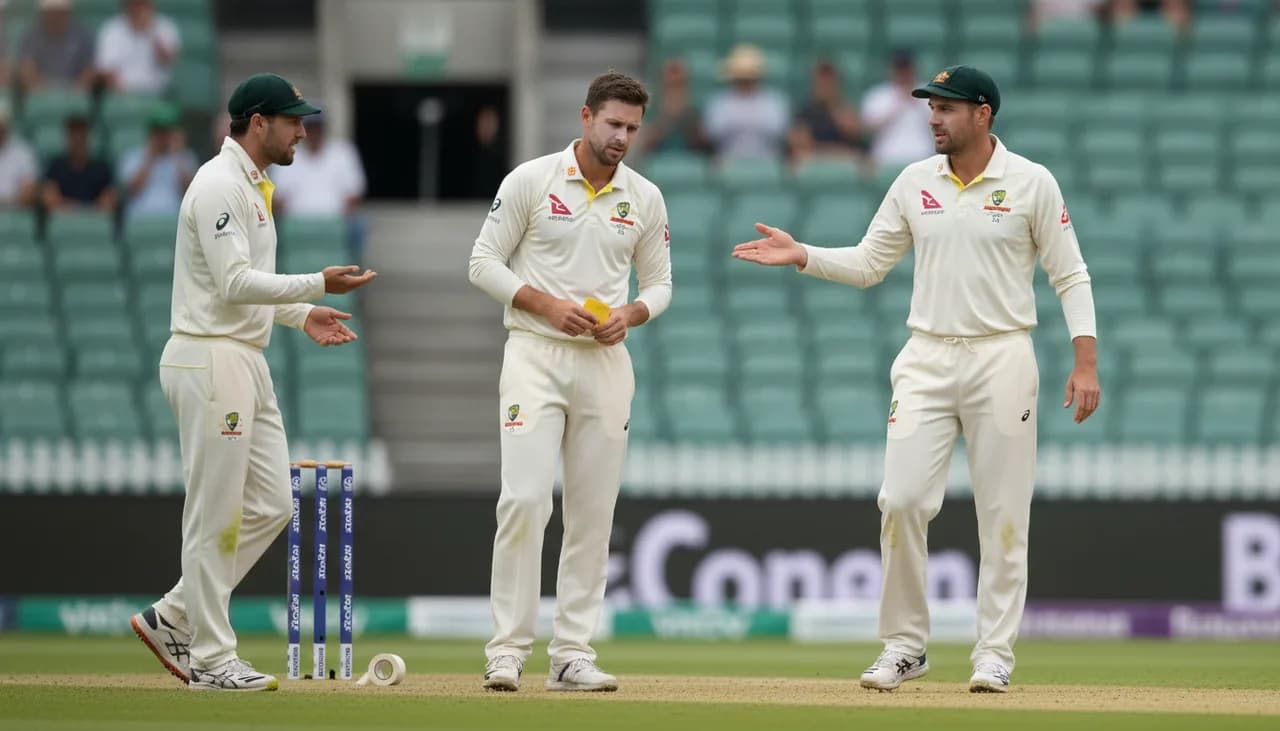
LONDON — England men’s cricket head coach Brendon McCullum has conceded that an altercation between a member of the team’s security staff and a television cameraman at Heathrow Airport “wasn’t ideal”, as the squad departed for their white-ball tour of New Zealand.
The incident, captured on video and widely circulated on social media, occurred on Monday, February 12th, as the England players and staff made their way through the terminal. The footage shows a member of the team’s security detail appearing to push a cameraman who was filming the group’s arrival.
Addressing the media in New Zealand ahead of the T20 series, McCullum acknowledged the situation but sought to downplay its significance in the broader context of the team’s preparations. "It wasn't ideal, was it? But it is what it is, and we'll deal with it in the appropriate manner," he stated.
The Incident and Immediate Fallout
The video evidence sparked immediate debate about the boundaries between media access and team privacy. In the clip, the security officer, whose primary role is to ensure the safe and unimpeded movement of the squad, is seen making contact with the camera and its operator.
While no official complaint was filed with the police, the England and Wales Cricket Board (ECB) confirmed it was looking into the matter. An ECB spokesperson said, "We are aware of an incident at Heathrow Airport and are looking into the matter."
The incident highlights the perennial tension at major airports, where traveling sports teams are often followed by media seeking footage. The key points of contention typically revolve around:
- Player Safety & Privacy: Teams argue for a bubble of personal space, especially in crowded public areas.
- Media Rights & Access: Broadcasters and agencies contend they have a right to film in public areas for news purposes.
- De-escalation Protocols: The preferred method for security to block filming without physical contact is to use a bag or clipboard.
McCullum’s Focus Remains On-Field
Clearly keen to shift the narrative back to cricket, McCullum emphasized that the airport episode would not distract his team from their on-field objectives. "We don't want to be too fussed about it," he said, adding, "The guys are in good spirits. We've had a good couple of days' preparation and we're looking forward to the series."
This tour marks a significant return for McCullum, the former New Zealand captain, now coaching against his homeland. The series comprises four T20 Internationals, beginning in Wellington on August 30th, followed by three ODIs.
A History of High-Profile Airport Clashes
This is not the first time an England cricket tour has been preceded by airport drama. Notably, in 2017, all-rounder Ben Stokes was involved in an altercation outside a Bristol nightclub, an incident that led to a court case and a significant period out of the team.
While the Heathrow incident is of a different nature and severity, it underscores how moments of friction in transit can become unwanted headlines. For a team management group, led by Director of Cricket Rob Key and McCullum, that prides itself on a progressive, positive environment, such negative publicity is an unwelcome distraction.
The Broader Security Context
Professional sports teams employ dedicated security personnel for legitimate reasons, including managing enthusiastic crowds, preventing unauthorized approaches, and ensuring player welfare in congested spaces. The individual involved in the Heathrow incident was part of this specialized detail, not a member of the airport’s own security.
The challenge lies in balancing vigilant protection with proportionate conduct. A statement from the International Federation of Television Archives (FIAT/IFTA) on media rights often cites that "the right to gather news in public places is a cornerstone of a free press."
In this case, the line between assertive protection and overly aggressive conduct appears to have been blurred. The ECB’s internal review will likely focus on refining protocols to ensure security staff are trained to handle such common scenarios with minimal confrontation.
Looking Ahead to the Cricket
Despite the off-field noise, the cricket itself presents a fascinating contest. England, the reigning T20 World Champions, are using the series as a crucial building block towards defending their title in the Caribbean and USA later this year.
New Zealand, always formidable at home, will provide stern opposition. The series also offers England a chance to integrate returning players like pace bowler Jofra Archer, who is on the comeback trail from long-term injury.
McCullum concluded his remarks by reiterating his team’s focus: "It's great to be back here in New Zealand, a place I know very well. The lads are excited to play some good, attacking cricket, which is what we're known for."
Conclusion: A Lesson in Composure
The Heathrow airport incident, while minor in the grand scheme, serves as a reminder of the intense, 24/7 scrutiny faced by modern sports teams. Every movement, especially in the age of smartphones, can become a public event.
Brendon McCullum’s handling of the query—acknowledging the issue without fueling the fire—reflects the calm leadership style he has brought to the England setup. By labeling it “not ideal” and committing to deal with it appropriately, he has effectively contained the story.
The ECB’s review will be conducted, protocols may be tweaked, but the spotlight will now rightly return to the cricket field. For England’s ‘Bazball’ era, defined by fearless play, the true test remains navigating such off-field distractions without letting them impact the aggressive, positive brand of cricket they have become famous for.