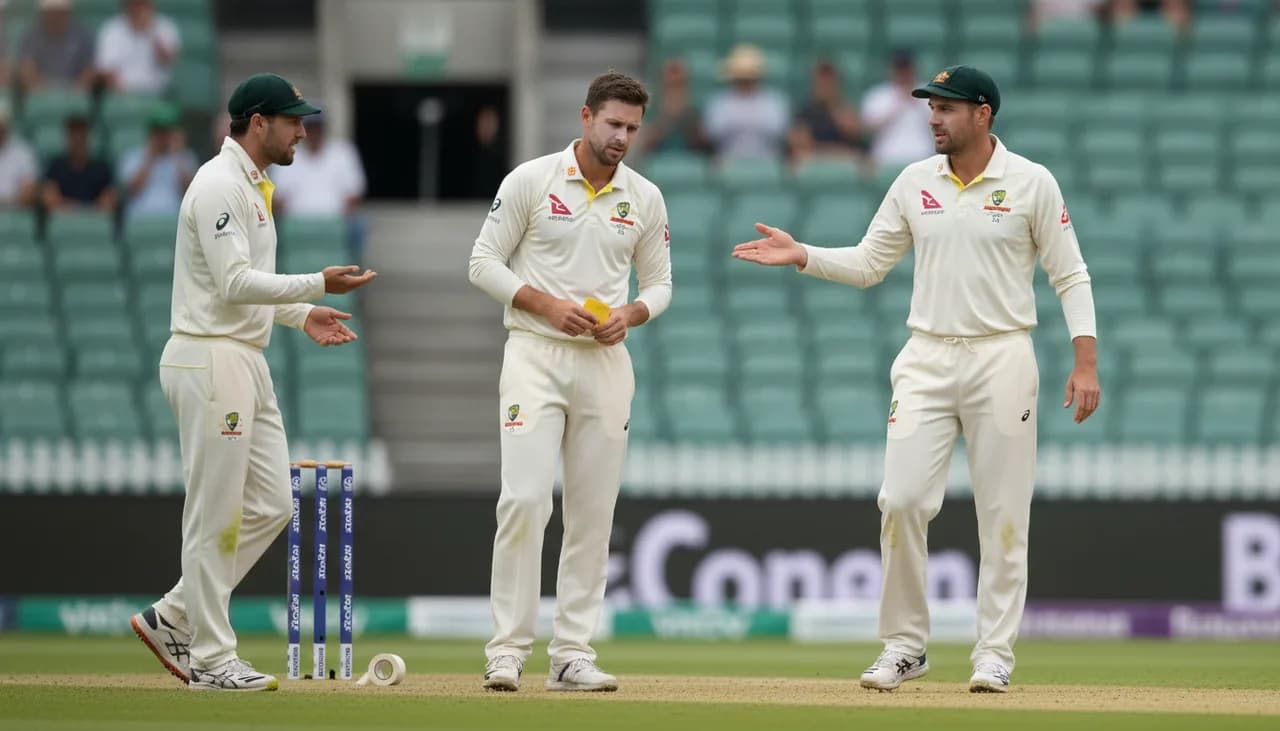
BRISBANE — Under the blazing lights of the Gabba, England’s cricketers summoned a defiant spirit on Friday evening, but the mountain they must climb to save the second Ashes Test and keep the series alive remains dauntingly steep. A late flurry of wickets, inspired by a rejuvenated Stuart Broad, gave the tourists a flicker of hope, but Australia’s commanding first-innings total of 379 and a lead of 91 runs leaves England facing a monumental battle over the final three days.
A Day of Australian Dominance
The narrative of the day’s first two sessions was one of familiar Australian control. Resuming on 279-6, the hosts’ lower order, led by the irrepressible Alex Carey, frustrated England’s bowlers. Carey, compiling a polished 65, found able allies in Mitchell Starc and Pat Cummins, who both chipped in with vital runs to push the total beyond 350. England’s frustration was compounded by missed opportunities; a dropped catch and several near-misses allowed Australia to build a potentially decisive advantage. As the shadows lengthened across the iconic ground, the scoreboard pressure was firmly on the tourists.
The Floodlit Fightback
Just as Australian momentum seemed unassailable, England’s veteran campaigner, Stuart Broad, ignited the fightback. With the pink ball under lights beginning to swing, Broad produced a spell of old-fashioned hostility. He removed the dangerous Cameron Green, before cleaning up Nathan Lyon and Josh Hazlewood in quick succession to finish with figures of 4-70. The late collapse, which saw Australia lose their final four wickets for just 23 runs, injected a dose of adrenaline into the English camp and their travelling ‘Barmy Army’ supporters. Captain Ben Stokes acknowledged the shift, stating, "That period under lights was exactly what we needed. Broady led the charge and showed the fight we have in this group."
England's Rocky Start
Any optimism generated by the bowling fightback was swiftly challenged as England began their second innings, still 54 runs adrift. The top order, for the second time in the match, faltered against Australia’s relentless pace attack. Josh Hazlewood, extracting steep bounce, removed Ben Duckett and Ollie Pope cheaply, while Pat Cummins produced a near-unplayable delivery to dismiss the out-of-form Joe Root for a second low score. At 28-3, England’s position was perilous, their fightback threatening to be rendered irrelevant.
The Stubborn Rebuild
Facing a potential innings defeat inside three days, the experienced heads of Zak Crawley and Ben Stokes embarked on a critical salvage operation. Crawley, looking more assured than at any point in the series, combined solid defence with crisp driving. Stokes, initially watchful, began to counter-punch as the Australian bowlers tired. Their unbroken 42-run partnership guided England to stumps at 70-3, a lead of just 19 runs. The pair’s resilience means the Test is alive, but the scale of the task ahead is immense. As Australian great Ricky Ponting noted in commentary, "England have shown they won’t lie down, but they need this partnership to go very big tomorrow. The new ball in the morning is absolutely massive."
The Mountain to Climb
England’s immediate goal is simple yet extraordinarily difficult: bat for the majority of day three to set Australia a challenging fourth-innings target on a wearing Gabba pitch. History is not on their side; no team has ever won a Test at the Gabba after conceding a first-innings deficit of 90 or more. The challenges are multifaceted:
- The Pitch: Cracks are beginning to widen, offering increasing variable bounce and turn for Nathan Lyon.
- The New Ball: Due in 10 overs, it represents a huge hurdle for Crawley and Stokes to overcome.
- The Lower Order: England’s tail must contribute significantly, a weakness exposed in the first innings.
- Scoreboard Pressure: Every run added is a brick in a defensive wall Australia must eventually tear down.
Australian captain Pat Cummins, while respectful of the fightback, was bullish about his side’s position. "We’re in a really good spot," he said at the close. "To get three wickets tonight was perfect. We know if we bowl well tomorrow morning and get a couple of quick ones, we’re right into them. The pitch is doing a bit, and we’ve got a world-class spinner to come into the game."
A Series at a Crossroads
The significance of this day-three battle cannot be overstated. For Australia, victory would secure a 2-0 series lead, a position from which they have never lost an Ashes series. The aura of invincibility at home would be fully restored. For England, defeat would mean the urn is all but lost, extending their winless run in Australia to over a decade. However, a miraculous rearguard would not only level the series but fundamentally shift the momentum and belief within both camps. It would prove that their aggressive ‘Bazball’ philosophy can withstand the fiercest pressure.
The Gabba, a fortress where Australia hasn’t lost a Test since 1988, awaits. England’s fightback under lights was a testament to their character, but as coach Brendon McCullum likely impressed upon his team, it was merely the first step in a marathon salvage operation. The equation is now brutally clear: bat long, bat big, and hope their bowlers can work miracles on a fifth-day pitch. The Ashes, for all intents and purposes, hinge on the resolve of Crawley, Stokes, and the English batters to come. As Stokes walked off under the lights, he carried not just his team’s hopes, but the very fate of the series on his shoulders.