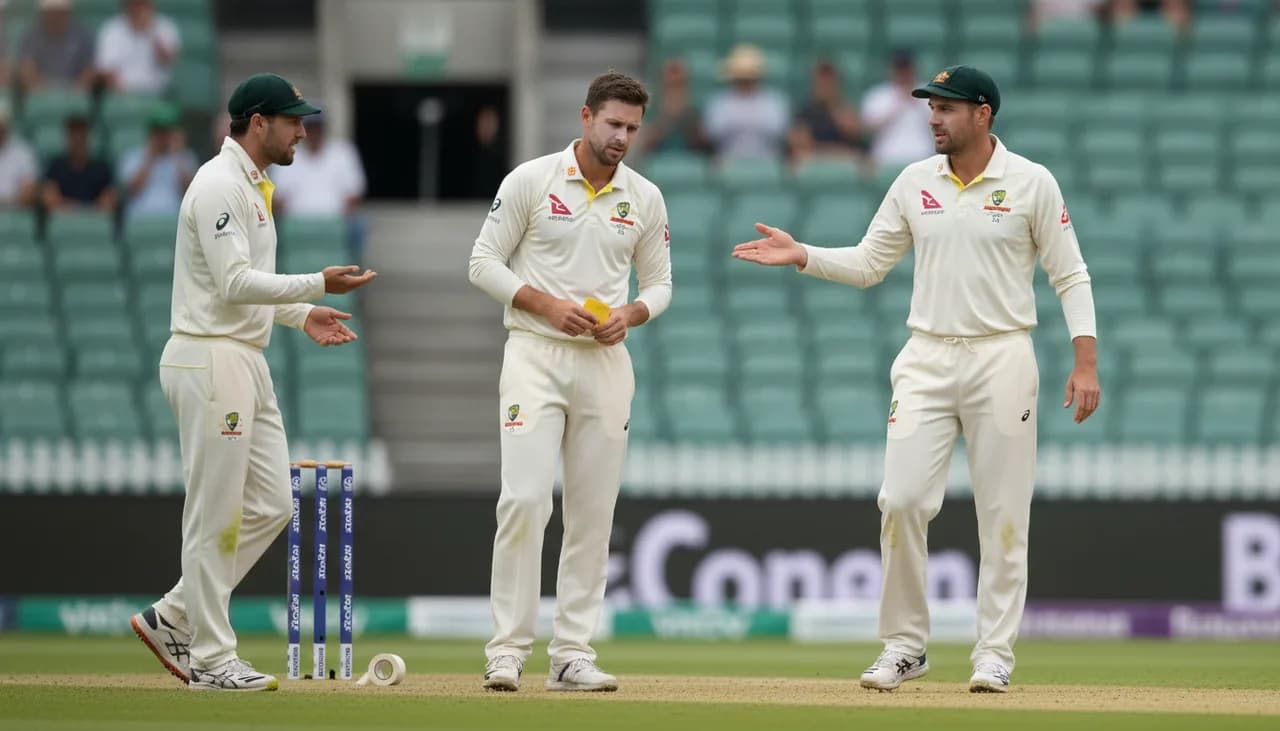
LONDON — The cricketing world is in mourning following the announcement that former England batter Robin Smith has died at the age of 62. A statement from his family confirmed he passed away peacefully in his sleep in Cape Town, South Africa, after a period of illness. Smith, affectionately known as "The Judge" for his ability to adjudicate on the bowling, was a cornerstone of the England batting lineup in the late 1980s and early 1990s, renowned for his fearless and combative approach against the world's most fearsome fast bowlers.
Smith's international career spanned from 1988 to 1996, a period defined by some of the most hostile fast bowling attacks in history. He carved out a reputation as England's premier player of pace, standing tall and delivering brutal hooks and cuts against the likes of the West Indian quartet of Ambrose, Walsh, Bishop, and Patterson, as well as Australia's Craig McDermott and Merv Hughes. His technique and courage made him a fan favourite and a respected adversary, embodying the spirit of a fighter in an often-beleaguered side.
A Formidable Record Against the Best
Robin Smith's Test statistics—4,236 runs at an average of 43.67 with nine centuries—only tell part of the story. His true value was measured in the context of his performances. He scored his maiden Test century, a match-saving 128, against the West Indies at Lord's in 1991, an innings that announced his arrival at the highest level. His highest score of 175 came against the same opposition at The Oval in 1993, a brutal assault that included 24 fours and a six. Perhaps his most iconic innings was a blistering 148-ball 167 not out in the 1993 Ashes at Edgbaston, a one-day international masterclass that showcased his power and range.
Former teammates and opponents were quick to pay tribute, highlighting his unique qualities. England's captain during much of Smith's career, Graham Gooch, said, "Robin was the ultimate competitor. He relished the challenge of facing the quickest bowlers and had the technique and heart to succeed. Away from the field, he was a great team man, full of spirit and fun. He will be deeply missed." Australian fast bowler Merv Hughes, a frequent foe, echoed the sentiment, calling Smith "one of the bravest blokes I ever bowled to."
The Judge's Gavel Falls: A Career Cut Short
Despite his obvious talents, Smith's international career was arguably shorter than it should have been. The rise of the "Dukes" ball in English county cricket, which promoted prodigious seam movement, exposed a perceived weakness against high-quality swing bowling. This, combined with the emergence of new batting talent, saw him play his final Test in 1996. His departure from the international scene left a void of grit and aggression at the top of the order that England struggled to fill for years.
Smith continued to be a prolific run-scorer for Hampshire, whom he captained with distinction, until his retirement from first-class cricket in 2003. His contribution to the county was immense, and he remained a beloved figure at the Ageas Bowl. In a statement, Hampshire Cricket said, "Robin Smith was a Hampshire legend. His fearless batting, leadership, and unwavering commitment to the club inspired a generation. Our thoughts are with his family and friends."
A Legacy of Courage and Character
Beyond the statistics and memorable innings, Robin Smith's legacy is one of immense courage and infectious character. He played the game with a visible passion and a smile, even in the heat of battle. His nickname, "The Judge," originated from his brother and Hampshire teammate, Chris "The Shred" Smith, but it perfectly captured his authoritative presence at the crease. He was a cricketer who made difficult conditions and terrifying bowling look conquerable, providing hope and excitement for England supporters during a challenging era.
In recent years, Smith had been open about his struggles with mental health following his retirement, speaking candidly about the difficulty of transitioning away from the adrenaline of professional sport. He became an advocate for mental wellbeing, using his platform to help others. This vulnerability added a profound layer to his legacy, showing the same bravery off the field as he had shown on it. His key contributions to cricket can be summarised as:
- Master of Pace: One of England's finest ever players of fast bowling.
- Iconic Innings: Memorable centuries against the West Indies and Australia.
- Fearless Competitor: Embodied the fighting spirit for England in the 1990s.
Final Tributes and Farewell
The news of his passing has triggered an outpouring of grief from across the global cricket community. The England and Wales Cricket Board (ECB) described him as "a feared competitor and a beloved figure." Former teammate and fellow batsman, Mark Ramprakash, tweeted, "Devastated to hear the news about Robin Smith. An outstanding batsman, a wonderful teammate, and a fantastic guy who was so well-liked and respected in the game. My thoughts are with his family." Flags at cricket grounds across the UK were flown at half-mast in his honour.
Robin Smith's death marks the loss of a genuine cricketing warrior. In an age of helmets and protective gear, his technique and mental fortitude were his primary defence, and he wielded them with glorious effectiveness. He provided some of the most thrilling and defiant batting performances of his generation, facing down the most intimidating challenges with a blend of skill, power, and unshakeable resolve. As the tributes continue to flow, it is clear that "The Judge" has delivered a final, enduring verdict: he will be remembered as one of English cricket's bravest and most charismatic sons.
His family has requested privacy at this difficult time but expressed their gratitude for the many messages of love and support, stating, "Robin lived his life with the same courage and passion he displayed on the cricket field. He was a loving father, husband, and brother, and we will miss him more than words can say."