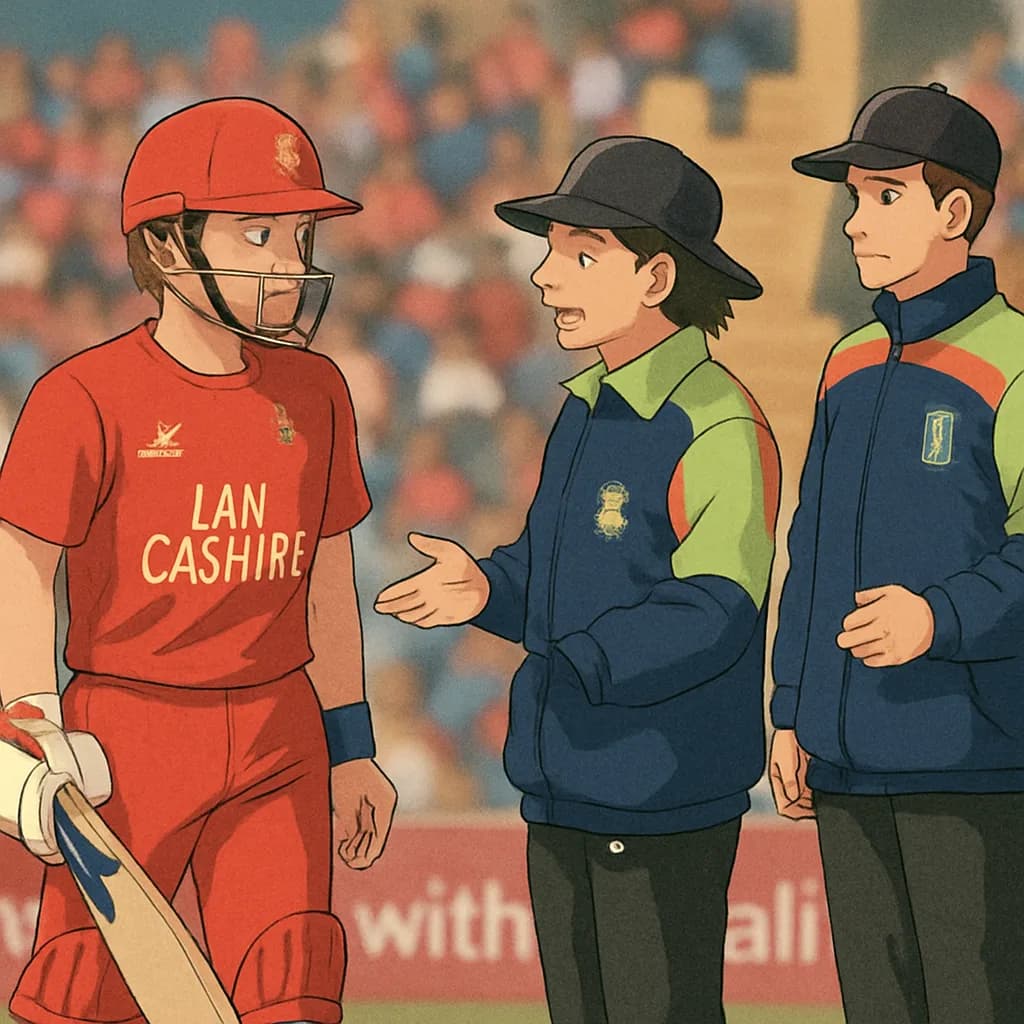
LANCASHIRE — Lancashire Cricket has issued a strong statement condemning the "misogynistic comments" and abuse directed at match officials on social media following a controversial lbw decision against their batter, Liam Livingstone, during the County Championship match against Surrey at Old Trafford.
The incident occurred on the third day of the Division One fixture. Livingstone, the England white-ball star, was given out by umpires James Middlebrook and Nigel Llong after being struck on the pad by a delivery from Surrey's Dan Worrall. The decision, which appeared contentious to many viewers on the live stream, sparked immediate and fierce debate online.
However, the club's focus swiftly shifted from the cricketing debate to the deplorable nature of the online response. In their statement, Lancashire said, "Lancashire Cricket is aware of inappropriate comments, including misogynistic comments, made on social media in response to Liam Livingstone's dismissal in our current men's match against Surrey. The club does not condone any form of abuse or discrimination and will continue to work to ensure cricket is a game for everyone."
The On-Field Incident and Its Aftermath
The dismissal itself was a key moment in a tightly contested match. Livingstone, on 12 runs, was trapped in front by a full, straight delivery from Worrall that skidded on. Umpire Llong raised his finger after a confident appeal. Livingstone reviewed the decision, but with the ball-tracking technology known as Hawk-Eye indicating the ball was clipping the top of the leg stump, the on-field decision was upheld.
While the "Umpire's Call" outcome left room for sporting debate, the reaction on platforms like X (formerly Twitter) quickly spiraled into unacceptable territory. A portion of the criticism was not aimed at the perceived error but was instead directed personally at the officials, with some users employing blatantly sexist language.
This is because the decision, while given by Nigel Llong, was informed by the Hawk-Eye technology, which is operated by a team of trained professionals, including women. The abuse, therefore, targeted not just the on-field umpires but also the officials operating the technology off the field.
A Wider Problem in Cricket and Sport
Lancashire's statement highlights a persistent and ugly issue within modern sport: the toxic nature of online abuse directed at officials. Match officials across all sports have increasingly become targets for vitriol from anonymous social media accounts, a trend that has raised serious concerns about their welfare and the potential impact on recruitment and retention.
The England and Wales Cricket Board (ECB) has its own set of protocols and disciplinary measures to tackle abuse. Their stated position is one of zero tolerance, and they have previously taken action against individuals for comments made online. The ECB's own social media policy for participants strictly prohibits such behavior.
An ECB spokesperson echoed Lancashire's sentiments, stating, "There is no place for abuse of any kind in cricket, and we fully support Lancashire Cricket's condemnation of the misogynistic comments made online. We are investigating the matter and will take appropriate action where necessary. The role of our match officials, both on and off the field, is vital, and they deserve to be treated with respect."
The Toll on Officials and the "Umpire's Call" Rule
The controversy also reignites the perennial debate around the "Umpire's Call" element of the Decision Review System (DRS). The rule is designed to preserve the authority of the on-field umpire, acknowledging the inherent margin of error in ball-tracking technology. However, it frequently leaves fans and players frustrated when a decision that appears incorrect to the naked eye is allowed to stand.
Key arguments in the DRS debate include:
- Preserving Umpire's Authority: The system is intended to overturn howlers, not to re-referee the game.
- Margin of Error: Hawk-Eye admits a small degree of uncertainty in its projections, which "Umpire's Call" accounts for.
- Consistency vs. Perfection: The system aims for consistent application of the rules rather than an unattainable perfection.
- Player Understanding: Many within the game, including Livingstone himself, have accepted the mechanism.
Following his dismissal, Livingstone was pragmatic, telling reporters after the day's play, "It's one of those things. It was Umpire's Call, clipping the stumps. The umpire gave me out, so it stays with the umpire's call. That's just the way it is. You have to get on with it."
Condemnation and Calls for Respect
The cricketing community largely rallied behind Lancashire's stance. Former players, journalists, and fans took to social media to condemn the misogynistic abuse and to call for greater respect for officials. The Professional Cricketers' Association (PCA) also reinforced the message, emphasizing that while competitive passion is welcomed, it must never cross the line into personal abuse.
The incident serves as a stark reminder that the conversation around contentious moments in sport must remain focused on the game itself. As Lancashire's statement concluded, "We encourage all fans to enjoy the game and debate the moments within it, but to always do so with respect for all involved."
The hope now is that the strong, unified response from the county club and the national governing body will deter future abuse and foster a more respectful environment for the volunteers and professionals who officiate the game at all levels. The match itself ended in a draw, with Surrey taking 13 points and Lancashire 12, but the wider discussion about conduct and respect is one that continues long after the stumps were pulled.