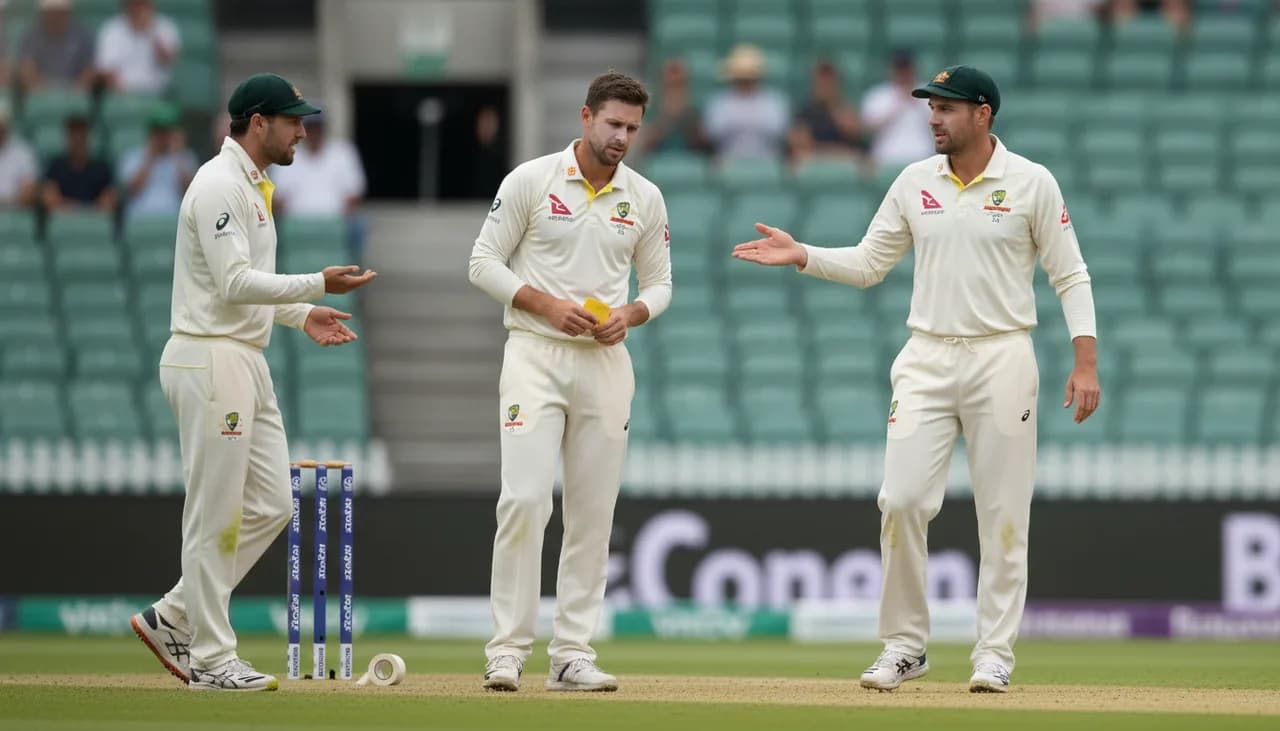
LEEDS — The company behind the Snickometer technology has accepted "full responsibility" for a critical operator error that led to Australia wicketkeeper Alex Carey being incorrectly reprieved on day one of the pivotal third Ashes Test at Headingley, a mistake that could have significantly altered the course of the match and the series.
The incident occurred during a tense morning session on Thursday. England's Jonny Bairstow, on just 6 runs, edged a delivery from Mitchell Starc that appeared to carry through to Carey. The Australians appealed vociferously for a catch, but on-field umpires Joel Wilson and Kumar Dharmasena were unmoved. Australia captain Pat Cummins immediately signalled for a review, with the decision sent to third umpire Nitin Menon with the soft signal of 'not out'.
The Technology and the Critical Error
The review process hinged on two key pieces of technology: the side-on Hot Spot camera and the audio-based Snickometer (Snicko). Initial replays showed a faint mark on Hot Spot on the inside edge of Bairstow's bat. However, when the crucial Snicko audio waveform was displayed, it was not synced correctly to the video footage. The spike in the audio graph, which should have aligned perfectly with the moment the ball passed the bat, appeared a full frame *after* the ball was beside the bat.
This misalignment created the illusion that the sound picked up by the stump microphone was not related to the bat. Based on this erroneous data, third umpire Menon concluded there was "clear gap between the bat and the ball" and that the Hot Spot mark must have been from the bat hitting the pad. He instructed the on-field umpires to overturn their soft signal and rule Bairstow not out. The explanation broadcast to the crowd stated, "There is a spike, but the spike comes after the ball has passed the bat."
It was a decision that left the Australian camp visibly stunned and sparked immediate controversy among commentators and fans. Replays from the host broadcaster, Sky Sports, which uses its own independently calibrated Snicko, clearly showed the audio spike syncing with the ball passing the bat. The discrepancy pointed to a fundamental error in the Official DRS feed provided to the third umpire.
Broadcast Dynamics and Official Admission
The confusion was exacerbated by the dual-broadcast setup in place for the Ashes. While the world feed, used by most international broadcasters, displayed the misaligned Snicko, the UK's host broadcaster, Sky Sports, had its own separate and correctly synced technology. This created the surreal scenario where viewers in different countries were seeing contradictory evidence. Sky commentators, including former England captain Nasser Hussain, were openly critical of the decision based on their feed.
Within hours, an official statement from the England and Wales Cricket Board (ECB), on behalf of the technology supplier, clarified the blunder. The statement read: "The technology company responsible for the Snickometer, which is used as part of the DRS, has advised that an operator error led to a miscalculation of the audio waveform which was displayed to the TV umpire. This resulted in an incorrect waveform being displayed. The operator is an experienced individual who has performed this role many times, but on this occasion, they made an error."
The statement confirmed that the error was isolated to the third umpire's feed and that the technology itself functioned correctly. It concluded with the company taking "full responsibility for this mistake and has apologised to the ICC and both teams." The International Cricket Council (ICC), which oversees the DRS protocol, acknowledged the error but stated the decision made by the third umpire was final and could not be retroactively changed.
The Potential Impact on the Ashes Battle
The reprieve proved monumentally costly for Australia. Jonny Bairstow, who had been struggling for form throughout the series, went on to play a blistering, counter-attacking innings. He smashed a run-a-ball 78, including 12 boundaries, forming a devastating 155-run partnership with Test newcomer Harry Brook. Their stand wrested the initiative away from Australia and propelled England to a competitive first-innings total of 237, a score that looked improbable when England were reeling at 68-4 and 142-5.
The ramifications of the error were multi-faceted:
- Match Context: Bairstow's innings was the cornerstone of England's total, giving their bowlers a tangible target to defend.
- Momentum Shift: The mistake visibly deflated the Australian attack and energized a raucous Headingley crowd.
- Series Context: With Australia leading the series 2-0, a win at Headingley was England's only hope of regaining the Ashes.
- Psychological Blow: It handed England a significant slice of fortune in a match they desperately needed to win.
Former Australian captain and commentator Ricky Ponting was scathing in his assessment on Sky Sports: "That is a huge error in a massive moment in an Ashes series. We've been talking about the umpires and the technology all series. This is the one that could have the biggest bearing on the outcome of a match and potentially the series."
Broader Questions for DRS Protocol
The incident has reignited the debate over the consistency and transparency of the Decision Review System. Key questions raised include the reliance on a single, fallible operator in high-stakes moments and the protocol for when broadcasters' technology conflicts with the official feed. Critics argue the third umpire should have access to, or be able to request, the host broadcaster's calibrated footage as a cross-check, especially when a decision seems incongruous with the visual evidence.
Furthermore, the "soft signal" from the on-field umpires, which was 'not out' in this case, remains a contentious part of the process. While designed to give weight to the on-field official's perspective, it can create a higher bar for overturning decisions. In this instance, the erroneous Snicko data made it impossible for the third umpire to find the "conclusive evidence" needed to overturn the soft signal, trapping him in a decision based on faulty information.
As the dust settles on a dramatic day's play, the episode serves as a stark reminder that while technology aims to eliminate human error, its implementation remains in human hands. The company's swift admission of fault is commendable, but it offers little consolation to an Australian team that saw a key dismissal vanish due to a procedural glitch. In an Ashes series decided by the finest margins, this operator error at Headingley may well be remembered as one of the most consequential technological mistakes in the history of the sport.