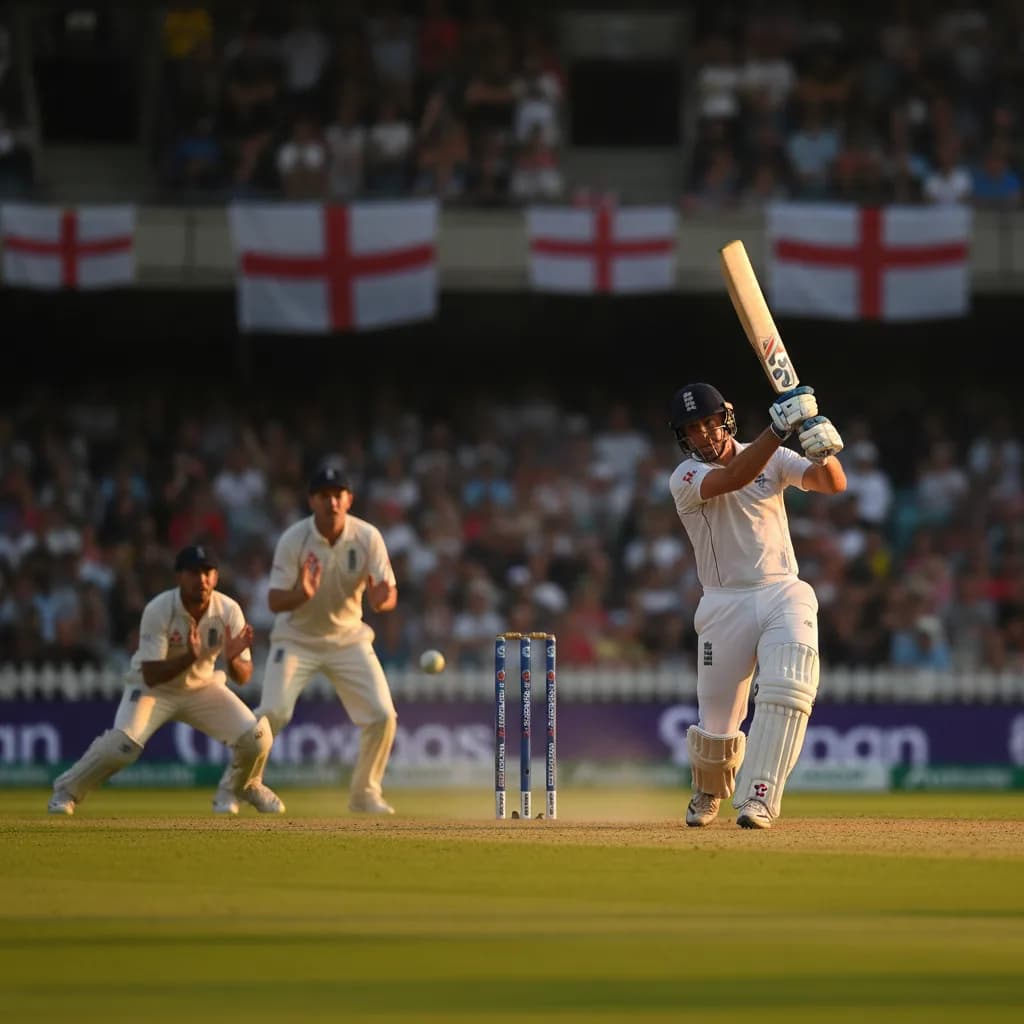
BENONI — In a display of batting that will be etched into the annals of youth cricket history, India's teenage prodigy Vaibhav Suryavanshi bludgeoned a breathtaking 175 from just 80 deliveries to power his nation to a commanding 94-run victory over England in the ICC Under-19 World Cup final at Willowmoore Park.
The 18-year-old right-hander from Uttar Pradesh played an innings of staggering power and audacious strokeplay, single-handedly dismantling a formidable English bowling attack. His century, the fastest ever in an Under-19 World Cup final, propelled India to a mammoth total of 326 for 7, a score that proved insurmountable as England were bowled out for 232 in 40.4 overs.
A Final Transformed by One Innings
The summit clash, watched by a packed stadium and a global television audience, was delicately poised after England won the toss and elected to field. Early swing and disciplined lines had India at a cautious 45 for 1 in the 10th over. What followed was not just a change of momentum, but a complete annihilation of the bowling plans. Suryavanshi, walking in at number three, announced his intent with a dismissive pull shot for six off his third ball. From that moment, the match ceased to be a contest and became a showcase.
Suryavanshi’s innings was a masterclass in modern limited-overs batting, blending pristine technique with fearless innovation. He peppered all corners of the ground, with his most devastating work coming in the arc between long-on and deep mid-wicket. English seamers searched for a yorker, only to see them launched over wide long-on. Spinners tossed it up, and were met with clean, monstrous hits down the ground. The statistics of his knock are scarcely believable:
- 175 runs from 80 balls (Strike Rate: 218.75)
- 14 sixes and 13 fours
- 100 reached in 48 balls, 150 in 70 balls
- 152-run partnership for the 4th wicket in 12.3 overs
England's Hopes Dashed by Relentless Assault
England's captain, Luc Benkenstein, tried seven different bowlers in a desperate attempt to stem the flow of runs. None were spared. The most expensive was left-arm spinner Tazeem Ali, whose two overs disappeared for 42 runs, including five sixes. Fast bowler Eddie Jack, one of the tournament's leading wicket-takers, saw his figures read a brutal 8-0-68-0. Suryavanshi’s dominance was so complete that at one stage he outscored the rest of his team combined.
The only respite for England came when Suryavanshi, attempting another heave over long-on off the bowling of Farhan Ahmed, was finally caught on the boundary in the 45th over. His walk back to the pavilion was met with a standing ovation from players, officials, and fans of both nations—a universal acknowledgment of witnessing something truly special. Indian captain Uday Saharan, who played a vital supporting role with a composed 58, could only watch in awe from the non-striker's end for much of their partnership.
A Captain's Praise and an Opponent's Respect
In the post-match presentation, a beaming but humble Suryavanshi dedicated his innings to his coaches and family. "I just wanted to play my natural game. The wicket was good, the ball was coming on nicely, and once I hit a few in the middle, I just kept going. It's a dream to score a century in a World Cup final, but 175... I cannot believe it," he said, clutching his Player of the Match award.
England's Benkenstein was gracious in defeat, acknowledging the sheer quality of the innings that had decided the contest. "We had a plan, but Vaibhav played an unbelievable knock. One of the best I've ever seen at any level. Sometimes you just have to hold your hands up and say, 'well played.'"
India's Bowlers Seal a Record-Extending Title
Chasing 327, England started with positive intent, with Benkenstein (38) and Jaydn Denly (28) putting on 61 for the first wicket. However, the required rate always loomed large. The introduction of India's spin twins, left-armer Saumy Pandey and off-spinner Priyanshu Moliya, applied a decisive brake. Pandey, the tournament's leading wicket-taker, was characteristically economical, taking 2 for 38, while Moliya’s 3 for 32 broke the backbone of the English middle order.
A late flurry from Noah Thain (38) and Ahmed (25) provided some entertainment, but the outcome was never in doubt. The final wicket fell in the 41st over, sparking wild celebrations in the Indian camp. This victory marks India's sixth Under-19 World Cup title, extending their own record and reaffirming the country's unparalleled depth of cricketing talent and its successful youth development pathway.
The Making of a New Star
Vaibhav Suryavanshi’s journey to this point has been one of relentless dedication. Hailing from a small town, he was identified early by state scouts for his clean hitting and calm temperament. His coach, former first-class player Ramesh Patel, noted, "What sets Vaibhav apart is his mindset. He has the confidence to trust his game on the biggest stage. Today, the world saw what we have known for some time."
The innings immediately drew comparisons to Kapil Dev’s legendary 175* against Zimbabwe in the 1983 World Cup and Yuvraj Singh’s blistering six-sixes assault in the 2007 T20 World Cup—iconic knocks that defined tournaments and announced legends. While it is far too early to place such burdens on a teenager, his performance has undoubtedly made him the most talked-about young cricketer on the planet.
As the Indian team lifted the trophy under the Benoni night sky, the story was unequivocally about one young man’s extraordinary talent. In a tournament designed to showcase the future of cricket, Vaibhav Suryavanshi didn't just show promise; he delivered a performance of such breathtaking dominance that it transcended the "Under-19" label. It was a senior-level innings played by a junior-level player, a knock that didn't just win a World Cup, but one that heralded the arrival of a potential superstar for the next generation.