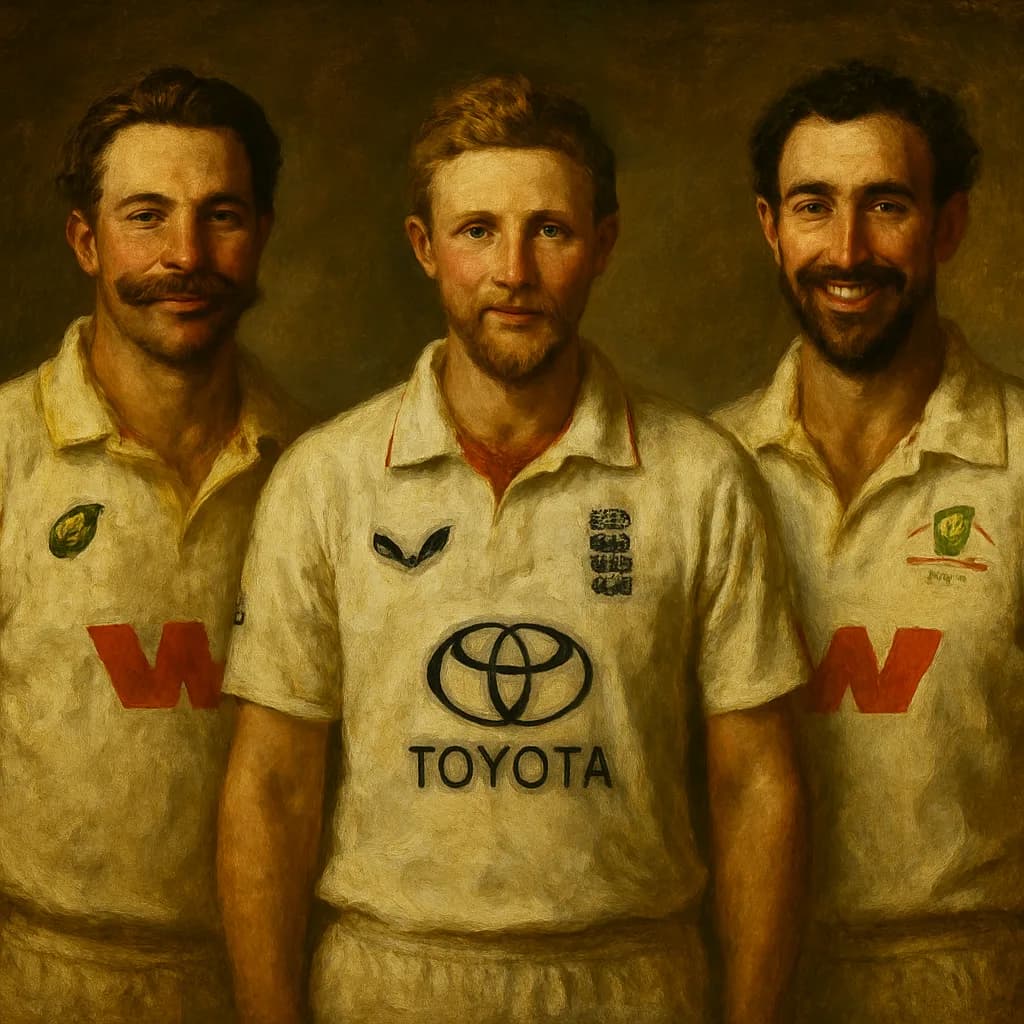
LONDON — Another unforgettable Ashes series has concluded, leaving a trail of broken records, heart-stopping drama, and the tantalising prospect of a 2-2 scoreline that somehow feels both fitting and frustrating. With the dust settling on a fifth and final Test that saw Australia retain the urn and England level the series, the debate now turns to the individual performances that defined the contest. So, who made the cut for the BBC Sport Team of the Series?
Selecting an XI from such a closely fought battle is a formidable task. This was a series where momentum swung violently, heroes emerged from unexpected quarters, and established stars were tested to their limits. Our selection criteria weighed not just raw statistics—though they are crucial—but also the magnitude of contributions under pressure and the ability to shape pivotal moments. The final team features six Australians and five Englishmen, a reflection of the narrowest of margins between the sides.
The Top Order: A Foundation of Class and Grit
1. Usman Khawaja (Australia) – The rock. Khawaja was the series' leading run-scorer with 496 at an average of 49.60, embodying resilience at the top of the order. His monumental 141 in the first Test at Edgbaston set the tone for Australia’s approach, and his crucial 77 in a low-scoring thriller at Lord’s was arguably more valuable. In a series where fast starts were gold dust, Khawaja’s obduracy was priceless. He faced more balls (1,263) than any other player, a testament to his importance.
2. Zak Crawley (England) – The statement-maker. While consistency eluded him, Crawley’s impact was seismic. His breathtaking 189 off 182 balls at Old Trafford was the innings of the series, a breathtaking assault that took the game away from Australia and showcased ‘Bazball’ at its most exhilarating. He finished as England’s leading run-scorer (480) and his series strike-rate of 88.72 redefined the possibilities of an Ashes opener. As one pundit noted, "He didn't just play innings; he played moods."
3. Marnus Labuschagne (Australia) – The technician who found his way. After a quiet start, the world’s number one batter roared back with a vital 111 at Manchester and a match-shaping 51 in the decisive first innings at The Oval. His partnership with Steve Smith at The Oval, weathering a fierce English attack, was a masterclass in application on a difficult pitch. He edges out England’s Ollie Pope, whose series was cruelly cut short by injury.
The Engine Room: Smith, Root, and the All-Rounder
4. Steve Smith (Australia) – The inevitable. While not at his transcendent best, Smith’s class and big-match temperament shone through. His 110 at Lord’s was a classic, grinding England into the dust, and his second-innings 71 at The Oval on a spiteful pitch was a display of technical genius under extreme pressure. He remains the batsman England fear most, a puzzle they never fully solved. His 373 runs came with two centuries that directly led to Australian victories.
5. Joe Root (England) – The artist. Root was England’s heartbeat, blending traditional excellence with thrilling innovation. His first-innings 118* at Edgbaston was a flawless counter-attack, while his 91 at Lord’s was a lone hand of the highest quality. He also contributed vital wickets with his off-spin, including the key scalp of Travis Head at Edgbaston. Root’s series was a highlight reel of reverse ramps, deft touches, and sheer batting intelligence, amassing 412 runs at 51.50.
6. Ben Stokes (England - Captain) – The phenomenon. The numbers (405 runs at 45.00) only tell half the story. His jaw-dropping 155 at Lord’s, a single-handed assault on an impossible target, will live forever in Ashes folklore. While his bowling was limited, his tactical bravery and ability to drag his team with him defined England’s spirit. As Australian coach Andrew McDonald conceded, "Stokes in that mode is the most difficult cricketer in the world to bowl to."
The Keeper and The Bowlers: Pace and Precision
7. Alex Carey (Australia - Wicketkeeper) – The silent assassin. Carey’s keeping was near-flawless, with 23 dismissals including a stunning one-handed grab to dismiss Root at Birmingham. With the bat, his contributions were critical: a counter-attacking 66 at Lord’s and a patient 28 in the run-chase at Edgbaston. He provided the lower-order steel Australia often needed, outshining his English counterpart with both gloves and bat in the key moments.
8. Pat Cummins (Australia) – The leader of the attack. The Australian captain carried a monumental burden and emerged with his reputation enhanced. His match-winning 6/91 at Edgbaston and his nerveless, unbeaten 44 to seal the win at Edgbaston were legendary. He took series-leading 18 wickets at 37.72, but his value was in bowling the tough overs, breaking partnerships, and captaining his side to urn retention on foreign soil.
9. Mitchell Starc (Australia) – The strike weapon. Despite being rotated, Starc’s impact was devastating. His nine-wicket haul at Headingley, including a blistering spell that ripped through England’s top order, kept Australia in a game they looked set to lose. He claimed crucial early wickets throughout and his 16 wickets came at a strike-rate of 43.1, the best of any frontline seamer. He provided the x-factor the Australian attack required.
10. Stuart Broad (England) – The warrior’s farewell. In his final series, Broad scripted a perfect ending. His spell of 4/17 on the fourth evening at The Oval was a vintage display of skill and will, breaking Australia’s resistance. He dismissed David Warner seven times in ten innings, a remarkable personal duel, and finished with 22 wickets. His passion and skill were emblematic of the entire contest.
11. Chris Woakes (England) – The player of the series. A revelation after being recalled at Headingley. Woakes was magnificent, claiming 19 wickets at an average of 18.14 and contributing vital runs. His match-winning 5/62 and 32* at Headingley, followed by 4/50 and 5/63 at The Oval, were series-defining performances. He mastered English conditions perfectly, finding movement and control that eluded others. As acknowledged by the BBC’s panel, he was the undisputed difference-maker in the latter stages.
Notable Omissions and Honourable Mentions
The strength of the series means several outstanding performers miss out. Their contributions, however, were immense:
- Mark Wood: His sheer pace at Headingley and Old Trafford was transformative, injecting fear and taking 14 wickets at 20.21.
- Travis Head: Played the most decisive counter-attacking knocks for Australia, including a vital 77 at The Oval.
- Mitchell Marsh: His stunning 118 at Headingley after a four-year Test absence was pure theatre.
- Josh Hazlewood: Relentlessly economical and threatening, with 16 wickets.
Conclusion: A Series of Fine Margins
This composite XI, like the series itself, is balanced on a knife-edge. It features the immovable object of Khawaja and the irresistible force of Crawley; the traditional mastery of Smith and the revolutionary flair of Root; the enduring class of Broad and the emergent brilliance of Woakes. The selection underscores that the 2023 Ashes was not won by one team, but shared by 22 players who produced a modern classic.
Ultimately, Australia’s key men delivered at the most critical junctures—Khawaja at Edgbaston, Smith at Lord’s, Cummins with bat and ball throughout. England’s heroes, particularly Stokes, Root, and Woakes, provided moments of sheer inspiration that ensured the urn was retained, not won outright. This team of the series is a tribute to a contest where the difference between triumph and despair was a matter of inches, a dropped catch, or a single session of brilliance. As the final stumps were drawn at The Oval, one sentiment was universal: "Cricket was the true winner." But for these eleven players, personal accolades are richly deserved.