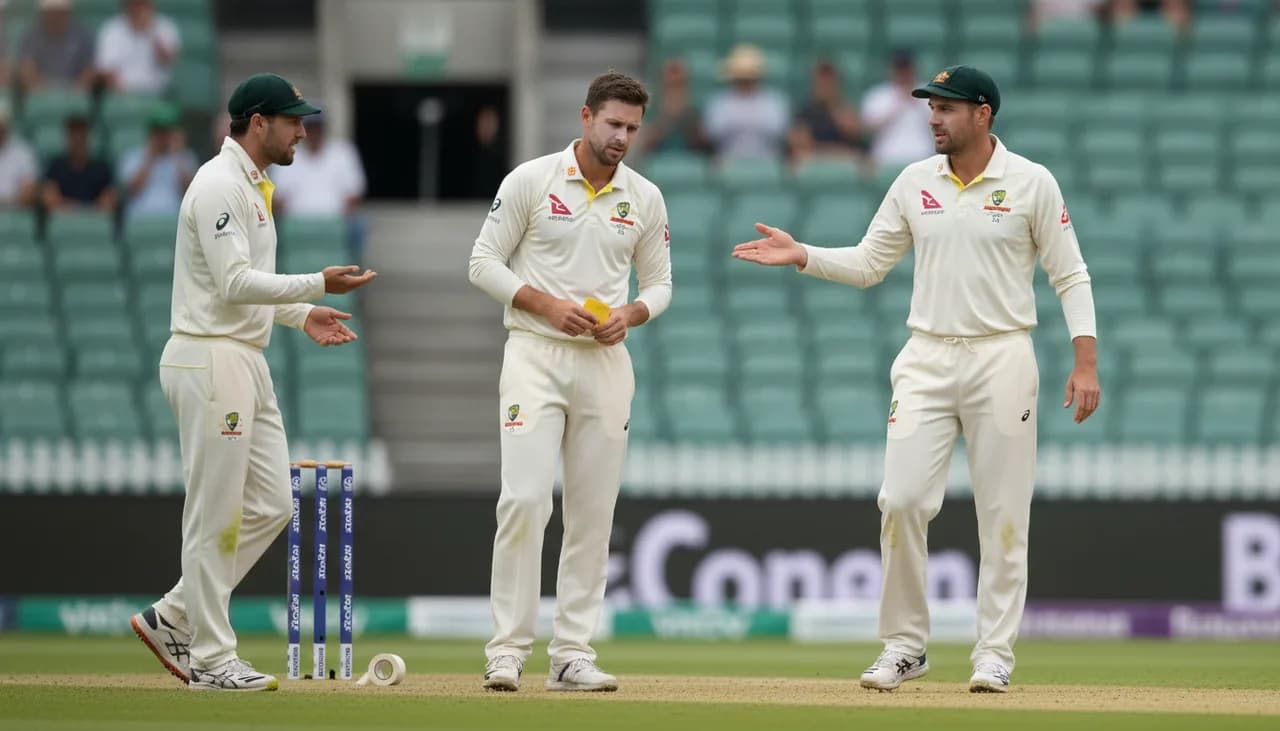
In the high-octane world of T20 cricket, where every ball is a potential game-changer, a new and initially perplexing tactic has emerged: batters voluntarily walking off the field, retiring themselves out, while seemingly still in good form. This isn't due to injury or illness, but a calculated strategic move. BBC Sport's Ask Me Anything team delves into the rationale behind this rising trend, explaining why a batter's early departure is becoming a weapon in the modern T20 captain's arsenal.
The Strategic Sacrifice: More Than Just a Walk
The concept is simple yet revolutionary. A batter, often one who has scored quickly but is perceived to be slowing down against certain types of bowling, will retire themselves to allow a fresher, potentially more explosive hitter to take their place. This is not a retirement hurt; it is a retirement out, meaning they cannot return to the crease later in the innings. The move, once considered against the spirit of the game by some purists, is now a data-driven ploy to maximize a team's run-scoring potential in the final, crucial overs.
The tactic gained global prominence during the 2022 Indian Premier League (IPL). Rajasthan Royals, a team known for its analytical approach, sent in the big-hitting Rovman Powell at number 4 against Gujarat Titans. When Powell's innings stalled against Rashid Khan's spin, he walked off at the end of the 18th over, retiring himself on 6 off 8 balls. In came the explosive Riyan Parag, who smashed 5 runs off 2 balls in the final over. Royals' Director of Cricket, Kumar Sangakkara, later explained the cold logic: "It was a team-first decision. We felt Riyan had a better match-up in that situation, and Rovman selflessly agreed."
The Driving Forces Behind the Trend
Several interconnected factors in modern T20 have converged to make this a viable, and sometimes optimal, strategy. The evolution of the game has shifted power from individual milestones to collective, situational efficiency.
1. The Rise of the Specialist Finisher
Modern T20 squads are packed with players possessing highly specific skills. Teams now carry dedicated "finishers" – batters who train specifically to score at astronomical rates from the first ball, often targeting specific ground dimensions or bowler types. If an anchor-style player is at the crease with five overs left, swapping them for a pre-identified finisher can be a net gain, even if the anchor is well-set.
2. Data Analytics and Match-Ups
Cricket is now governed by deep analytics. Teams have precise data on which batter performs best against which type of bowler (e.g., left-arm spin, death-over yorkers). If the data suggests the incoming player has a 40% advantage in that specific match-up, the retirement becomes a mathematical equation, not an emotional one. As ESPN Cricinfo's analyst noted, "It's the ultimate expression of match-up hunting. You're manually substituting your batter to create the most favorable condition."
3. The Impact Player Rule (in leagues like the IPL)
The introduction of the "Impact Player" rule in the IPL has supercharged this trend. Teams can now substitute a player at any point during the innings, effectively giving them 12 players to use. This has led to teams structuring their line-ups with "sacrificial" top-order batters whose primary role is to attack in the powerplay. Once their job is done, they can be retired out to bring in a designated middle-order hitter from the bench, seamlessly transitioning the innings' phase.
Notable Examples and Global Adoption
Beyond the IPL, the tactic has been employed in international cricket and other leagues. In a T20I against the Netherlands in 2022, Pakistan's Mohammad Rizwan retired himself out after a solid start, making way for the harder-hitting Khushdil Shah. Earlier, in a Bangladesh Premier League match, Shakib Al Hasan retired himself out to get a better hitter in during the chase.
The strategy requires a specific team culture and selfless players. The benefits are clear:
- Maximizes Run Potential: Ensures the best possible hitter is always facing, based on the game situation.
- Disrupts Bowling Plans: Forces the opposing captain to constantly rethink field placements and bowler choices.
- Utilizes Squad Depth: Turns a deep batting lineup into a tangible, tactical weapon rather than just insurance.
However, it is not without risk. Retiring a well-set batter can backfire spectacularly if the new batter fails immediately. It also depends entirely on player buy-in. Not every cricketer is willing to sacrifice their personal score for the team's potential gain, a cultural shift that coaches are now managing.
The Spirit of the Game and Future Evolution
Initially, the move raised eyebrows. Critics argued it was against the traditional "fight-it-out" spirit of cricket. However, the Laws of Cricket have always permitted a batter to retire out (Law 25.4). The consensus is shifting to view it as a legitimate, innovative tactic—no different than a strategic substitution in football or basketball. The focus is on winning within the rules, using every available tool.
Looking ahead, we can expect this trend to become more sophisticated. We might see:
- "Pre-planned retirements" in team tactics, announced at the toss.
- Increased use in bilateral series and World Cups as pressure intensifies.
- Debate on whether rules should be tweaked in response, though major changes seem unlikely.
As former England captain Nasser Hussain summarized, "It's a sign of how far T20 cricket has evolved. It's brutal, it's analytical, and it's completely team-oriented. The individual fifty is becoming subordinate to the team's 220."
Conclusion: A New Paradigm in Team Strategy
The trend of batters retiring out early is a definitive marker of T20 cricket's maturity. It underscores the format's shift from a showcase of individual brilliance to a complex, strategic team sport where resource management—including wickets as a renewable resource—is paramount. While it may seem counterintuitive, the act of a batter walking off is a powerful declaration of modern cricket's ethos: the team's total, and ultimately the win, is all that counts. As data becomes even more precise and player roles more specialized, this tactical retirement is likely to transition from a bold innovation to a standard, if situational, part of the T20 playbook.